A note on this investigation
Crypto Leaks collects and publishes covertly recorded video footage in the public interest, in accordance with the laws of the jurisdictions in which the recordings are made. The people named in this case were not contacted for comment before publication. Where we describe conduct as suspicious or unexplained, we are expressing our opinion that it warrants explanation, not stating that wrongdoing has been proven.
- We have not contacted the subjects of this article for comment.
- Readers should evaluate the evidence presented and draw their own conclusions.
- Sam Bankman-Fried has been convicted of financial crimes, but not charged regarding the specific matters in this case.
- The connections we document do not constitute proof of criminal conspiracy.
- When we characterize events as suspicious, or raising questions, we are expressing our opinion that the conduct warrants explanation, rather than stating that wrongdoing definitively occurred.
Key findings
- Sachin Dutta, Arkham Intelligence's former chief growth officer, says on video that Arkham paid M Group, a PR firm he calls "FTX's PR people," "a quarter of a million dollars every year" (about $275,000) when Arkham "hadn't even launched" a product.
- Dutta says he canceled the retainer as soon as he joined. Asked why Arkham had been paying, he says: "Well, I know it's a good question."
- M Group represented FTX and Sam Bankman-Fried, and sources quoted on X said it worked closely with Andrew Ross Sorkin of The New York Times, who published the Arkham report. M Group has denied influencing FTX coverage; it has not been asked about Arkham.
- Dutta says Arkham's leadership were "close friends" with the "FTX guy" and planned to launch the ARKM token on FTX.
- Jean Guillaume Brasier, a former Arkham analyst, says on video that Arkham's services were to be integrated into FTX, that Alameda Research was a customer, and that Arkham's leadership was with Bankman-Fried in the Bahamas the day before FTX failed.
- Dutta says Miguel Morel and Henry Fisher, Arkham's CEO and CTO, had met Bankman-Fried; Brasier says they knew FTX's CTO, Gary Wang. A public tracing thread appears to show Fisher's wallet was first funded from an FTX wallet.
- Whether the retainer had anything to do with the Times' publication of the report is unproven and remains open.
Synopsis
In June 2021, The New York Times published a report by an unknown start-up, Arkham Intelligence, accusing the developers of the Internet Computer of dumping tokens on investors. Arkham's associates later said on tape that the report was made to order. This case adds a money trail. Arkham's former chief growth officer says on video that the company was paying about $275,000 a year to M Group, the PR firm that worked for FTX and Sam Bankman-Fried and was reported to work closely with the Times journalist who published the report. Arkham had no product to promote. Its founders, former staff say, were close to Bankman-Fried, on whose exchange Case 1 found ICP's launch price being set. What the retainer bought is the $275,000 question.
The $275,000 payment to M Group
Sachin Dutta was hired by Miguel Morel as Arkham's chief growth officer and was successful in the role; he also appears in Case 9. In the two recordings below he describes an arrangement with M Group that was in place before he arrived, and that he ended.
Clip 1 · DuttaM Group, "FTX's PR people", paid before Arkham had a product
On the payment:
| “ | they were paying way before they had a product. |
Asked why Arkham was paying:
| “ | Well, I know it's a good question. |
And on where it had been asked before:
| “ | That's what's been raised in the legal case. |
Clip 2 · Duttathe same PR team as FTX; he stopped the payments when he joined
| “ | the same PR team that was doing FTX so they were close friends with Sam Bankman-Fried |
| “ | yeah, I put a stop to that straight away when I came in because it was a quarter of a million dollars every year they were paying and they hadn't even launched. |
What to bear in mind
- M Group was a core part of FTX's PR operation.
- M Group boasts of close links to The New York Times.
- Dutta refers to M Group as "FTX's PR people."
- Arkham chose M Group over hundreds of other firms.
- According to Dutta, Arkham paid M Group $275,000 for PR services.
- $275,000 is an unusually large sum for a start-up to pay for PR.
- At the time, and for well over a year afterward, Arkham had no product that needed promoting.
- When Dutta joined, long after the Times had published the report, he canceled the arrangement. He does not say the founders ever explained it.
What is known about the timing
Dutta describes an annual retainer, running before Arkham had launched anything and ended when he joined. He gives no start date. The report was published on June 28, 2021; Arkham's first product came well over a year later. That the payments were under way when the Times published the report is our inference, not something Dutta states.
One line is unexplained. Dutta says the payment was "raised in the legal case," apparently meaning the DFINITY Foundation's defamation suit against the Times and Arkham; that suit made no mention of M Group or Bankman-Fried, and we cannot say what he was referring to.
Who M Group is
M Group Strategic Communications represented FTX and Bankman-Fried. In November 2022, as FTX failed, a widely followed account reported that the firm had worked closely with Sorkin to place articles in the Times.
A source has shared that FTX and Sam use M Group SC as their PR agency. They share that M Group has previously worked closely with Andrew Sorkin and the NYT to publish articles for PR purposes. They believe that this may explain the recent softer articles.https://t.co/a072rZ905x pic.twitter.com/gUOm75ozTE
— Autism Capital 🧩 (@AutismCapital) November 24, 2022
Three months earlier, another account had reported that M Group was placing negative stories about FTX's competitor Binance, with journalists offered a "black book" of contacts; coverage of problems at Binance followed.
A verified source has confirmed that FTX's PR firm, M Group Communications, has been contracted to release negative media articles about competitor exchange Binance. Hired journalists are given access to a "black book" of anti-Binance contacts & references for research.
— FatMan (@FatManTerra) August 24, 2022
The examiner's report filed in the FTX bankruptcy on May 23, 2024 appears to confirm that FTX paid M Group more than $3 million.
M Group responded the same day, and its denial should be read precisely. The firm confirmed it had represented FTX, said it stopped all work at the bankruptcy, and said it had "absolutely nothing to do with any current media coverage regarding the company or Sam." That concerns FTX coverage in late 2022. M Group was not asked about Arkham, and has not commented on the retainer Dutta describes.
1) We did represent FTX as their PR agency, but ceased all work upon the bankruptcy news, after being completely in the dark as to their fraudulent behavior. We have absolutely nothing to do with any current media coverage regarding the company or Sam. https://t.co/mp8Mn8rJWN
— M Group Strategic Communications (@MGroupSC) November 24, 2022
Our view: a start-up with no product, paying a quarter of a million dollars a year to the PR firm of a man its founders counted as a friend, when its only public output was a report the Times had just published, warrants explanation. It is not proof of anything. Nobody involved has offered one.
Arkham's ties to FTX
The six recordings below were first published in Case 10 on November 9, 2023. The speakers are Dutta and Jean Guillaume Brasier, who worked at Arkham for three months as an analyst after studying at Harvard and MIT.
Clip 3 · DuttaArkham's leadership were "close friends" with the "FTX guy", and planned to launch ARKM on FTX
Clip 4 · Brasierhis work analyzing cryptocurrency transactions at Arkham
Clip 5 · BrasierArkham's services were to be integrated into FTX; close ties to Alameda, which used them
Alameda Research was Bankman-Fried's hedge fund and market maker, through which, a federal jury found, FTX customer money was taken.
Clip 6 · Brasier"they were with Sam Bankman-Fried in the Bahamas" the day before FTX collapsed, "which was a bit weird"
| “ | involved in the FTX crash ... which was a bit weird ... they [Miguel Morel and Arkham] were with Sam Bankman-Fried in the Bahamas |
FTX failed in November 2022. That Arkham's leadership was with Bankman-Fried in its final days says something about the relationship.
Clip 7 · Duttahe never met Bankman-Fried himself; Arkham's CEO and CTO "definitely" had
Clip 8 · Brasier"they were friends with the CTO, Gary Wang ... that's how they got to know each other"
| “ | they were friends with the CTO, Gary Wang ... so that's how they got to know each other |
Wang co-founded FTX and has pleaded guilty to serious criminal charges. If Brasier is right, the connection predates Arkham and was personal before it was commercial. A thread published in July 2023 traces the wallet of Henry Fisher, Arkham's CTO, to its first deposit, which appears to have come from one of FTX's corporate wallets.
Background
The Internet Computer, a public blockchain built to work as a decentralized cloud platform, launched on May 10, 2021. Its ICP token opened at around $500, a fully diluted valuation of about $230 billion, and fell within hours. Case 1 presented evidence that the opening price was set by trading in ICP-PERP, a futures contract created on FTX days before launch. FTX was owned by Bankman-Fried, whose largest investments were in Solana, a blockchain some expected the Internet Computer to disrupt.
On June 28, 2021, Arkham published a report accusing the DFINITY Foundation, which built the network, of causing the fall by insider selling, and Sorkin published it in the Times. Case 2 presents recordings in which Arkham's associates say the report was made to order, and explains why a $500 launch price could only fall. Roche Freedman, a law firm, then filed a class action against DFINITY citing the report; Case 3 showed the firm was financed by Ava Labs, a competitor, and judges later removed it from several cases, including the DFINITY one.
As of November 5, 2025, neither Sorkin nor the Times had commented on any of this evidence. One question had never been answered: how Arkham, with no track record and a 21-year-old founder, got the Times' best-known business journalist to publish its report.
The key players
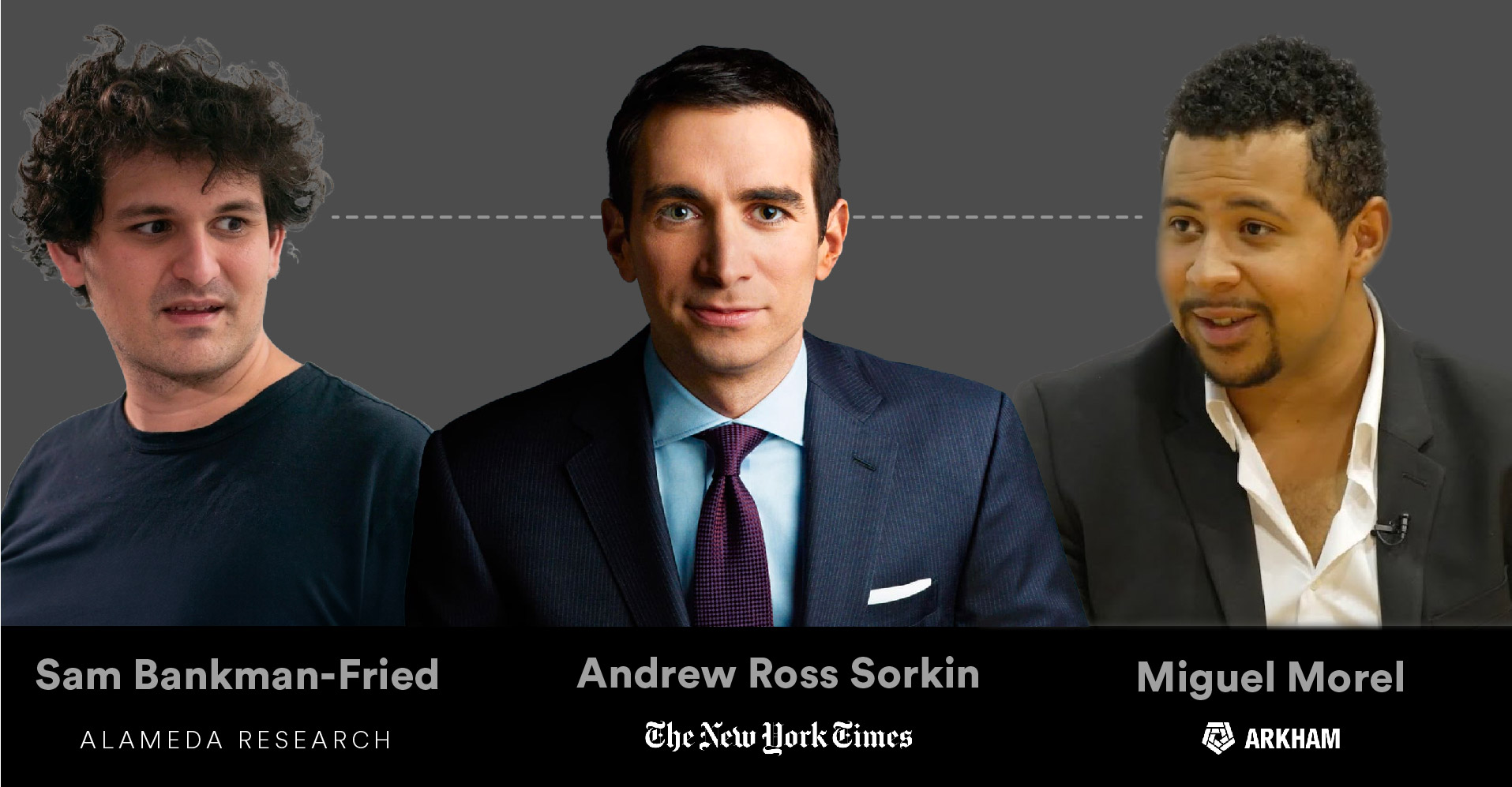
- Sam Bankman-Fried: former owner of FTX, a large cryptocurrency exchange, and of Alameda Research. He is serving 25 years in prison for what U.S. Attorney Damian Williams called "one of the biggest financial frauds in American history."
- Andrew Ross Sorkin: the Times' star business reporter, who called Bankman-Fried the "J.P. Morgan of Crypto" and invited him to speak at his DealBook conference alongside Janet Yellen and Volodymyr Zelenskyy.
- Miguel Morel: founder and CEO of Arkham Intelligence, 21 when the ICP report appeared. He came out of an offshoot of Leverage Research, a Californian group former members have described as a cult, linked to effective altruism, where he helped create a small-cap cryptocurrency.
Arkham today
After the report, Arkham's team moved from rural Texas to a house in Chelsea, London, and built a product that tracks cryptocurrency addresses and transactions, released well over a year later. By 2025 the company was building an international cryptocurrency exchange, buying defunct exchanges for their licenses and combining them under the Arkham brand. Exchange operators hold customer money; their integrity matters.
Between April and May 2025, Arkham lost its entire compliance team. What they found is the subject of Case 14; how Arkham entered the Turkish market is the subject of Case 13.
📢 Arkham Intelligence hired a compliance team for their crypto exchanges. Then the team left 🤔
— Crypto Leaks (@CryptoLeaksInfo) September 21, 2025
Brennan Long (Former FBI)
AVP, Team Lead - Compliance
Joined December 2024, Left April 2025
Adam Westwood-Booth
Head of Compliance
Joined September 2024, Left May 2025
Philip…
What happened next
After Case 2 was published on June 9, 2022, DFINITY sued the Times and Arkham for defamation. The suit was dismissed before trial for failure to plead actual malice, and the dismissal was affirmed on appeal in July 2024 (opinion; appeal); the payment described in this case was not before the court. Case 2 carries a special section setting out the evidence the court never weighed, the complexities of the case, and what difference that evidence would have made. While it was pending, on June 18, 2023, the Times published a profile of Kyle Roche, Roche Freedman's lead partner, which Case 7 examines.
On July 28, 2025, Roche, who had told the Times he was hiding in Brooklyn from people connected to DFINITY, publicized his purchase of "Buffalo's most expensive property." The story belongs to Case 7; the exhibits are kept here for the record.
Kyle Roche buys "Buffalo's most expensive property." Meanwhile in 2022 we revealed his firm received hundreds of millions of dollars worth of AVAX and Ava Labs stock to secretly attack their rivals – a "completely different way than a lawyer," he said
— Crypto Leaks (@CryptoLeaksInfo) July 28, 2025
🌐 https://t.co/BcO01irrvn pic.twitter.com/PRszQJ2lJf
What later cases revealed
This case left its central question open. The two cases that followed did not answer it, but showed, from two more sources inside the company, how Arkham went about its business. This section was added in the October 2026 revision.
- Case № 13Mar 2026
Arkham's head of Turkey described bribery, regulatory capture and a "black ops" budget, and said the CEO knew. In 30 recordings, Efe Buken says he dictated changes to Turkey's crypto rules through a contact at the regulator, obtained sealed documents that were handed to Morel in person, and arranged sex workers for Galatasaray's coach. Read Case 13.
- Case № 14Apr 2026
Arkham's former head of sanctions says Morel told compliance to "get to a yes" on EU-sanctioned eastern Ukraine. Dimitri Michaloutsos says the company had no working controls to block users in Iran, North Korea or Russia when he arrived, and that the compliance team left after refusing to approve the expansion. Read Case 14.
Neither case touches M Group or the Times. What they add is context: a company whose senior staff describe it, on tape, as willing to pay for outcomes is one in which an unexplained $275,000 retainer to a well-connected PR firm deserves an answer. We believe the findings hint at a larger story: who profited by trading the fall in ICP, and how they related to the report.
What must happen now
- Miguel Morel, Henry Fisher, Sam Bankman-Fried, Gary Wang and Andrew Ross Sorkin are invited to make statements, which we will publish.
- Arkham's current and former investor directors should press its leadership to explain the M Group retainer: when it began, what it was for, and who at M Group was engaged.
Video evidence index
Eight clips are embedded above, in the order they appear. Each entry links to the clip on this page and to its file.
- Dutta: M Group, "FTX's PR people", paid before Arkham had a product file
- Dutta: the same PR team as FTX; he stopped the payments when he joined file
- Dutta: Arkham's leadership were "close friends" with the "FTX guy", and planned to launch ARKM on FTX file
- Brasier: his work analyzing cryptocurrency transactions at Arkham file
- Brasier: Arkham's services were to be integrated into FTX; close ties to Alameda, which used them file
- Brasier: "they were with Sam Bankman-Fried in the Bahamas" the day before FTX collapsed, "which was a bit weird" file
- Dutta: he never met Bankman-Fried himself; Arkham's CEO and CTO "definitely" had file
- Brasier: "they were friends with the CTO, Gary Wang ... that's how they got to know each other" file