A note on this investigation
Crypto Leaks collects and publishes covertly recorded video footage in the public interest, in accordance with the laws of the jurisdictions in which the recordings are made. The evidence in this case is on-chain tracing data, published as a document in which every transaction opens in an independent block explorer; the one clip below is taken from Case 5. The people named in this case were not contacted for comment before publication. Where we describe conduct as suspicious or unexplained, we are expressing our opinion that it warrants explanation, not stating that wrongdoing has been proven.
Key findings
- Our tracing document, in which every transaction links to a public block explorer, shows the Avalanche Bridge, operated by Ava Labs, received assets worth more than $279.6 million from seven categories of malicious source: sanctioned addresses, mixers, stolen-funds wallets, illicit actors, high-risk exchanges, scammers and dark net markets.
- Bitcoin worth $59.45 million came from addresses that OFAC, the US Treasury's sanctions office, lists as belonging to Lazarus Group, a hacking group linked to the North Korean government.
- A further $36.8 million came from Sinbad.io, a mixer the document describes as associated with North Korean hackers, and $33.4 million from ChipMixer, seized by law enforcement in March 2023 according to reports the document cites.
- Ava Labs holds deposited assets in a single pool, so tainted deposits are commingled with those of ordinary users, who may receive stolen or sanctioned coins when they redeem; the whole pool is exposed to seizure.
- Evan Richards, a former senior Ava Labs engineer, says on video recorded for Case 5 that the bridge runs on code "no one's allowed to see" and that if three of its five operators "were hacked or just decided to collude, they could print an arbitrary amount of money."
Synopsis
Ava Labs, the company behind the Avalanche blockchain, runs the Avalanche Bridge. Users deposit bitcoin and Ethereum assets with it and receive "wrapped" copies to use on Avalanche; Ava Labs keeps the originals in a pool. Our tracing shows that the pool received more than $279.6 million from mixers, sanctioned addresses, dark net markets, high-risk exchanges, illicit actors, scammers and stolen-funds wallets. Nearly $60 million of it is bitcoin from addresses sanctioned as belonging to North Korea's Lazarus Group. Because the bridge is centralized and did not check the source of deposits, those assets now sit alongside the savings of retail users, who may get tainted coins back when they redeem. This case publishes the tracing data so that anyone can verify it, and asks Ava Labs to make its users whole.
What the tracing shows
The bridge accepts bitcoin and assets on Ethereum, including ether, Dai, Tether and USD Coin, and issues wrapped versions on Avalanche. Our tracing followed deposits into the bridge back to their sources. The full data is in c6-avalanche-bridge-disaster.pdf, a 25-page document in which each transaction can be clicked to open it in an independent block explorer. It states a total of "over USD 279,634,416.5 from malicious sources," three quarters of it in bitcoin. The table gives the inflows by source category as the document states them.
| Source category | Assets received (per the document) | USD value (per the document) |
|---|---|---|
| Sanctioned addresses (OFAC) | 2,586.45 BTC; 10,355,000 DAI; 268,830.5 USDT; 482 WBTC | $95,962,895 |
| of which Lazarus Group (OFAC SDN, September 13, 2019) | 2,410 BTC | $59,450,200 |
| Mixers | 3,322 BTC; 194,500 USDC | $73,739,800 |
| of which Sinbad.io | 1,687 BTC | $36,820,000 |
| of which ChipMixer.com | 1,465 BTC | $33,388,300 |
| Stolen-funds wallets | 3,032 BTC; 2,269 USDC; 31.05 WETH; 5.02 WBTC | $73,275,611 |
| Illicit actors | 1.01 BTC; 23,970,550 DAI; 1,605,700 USDC; 199,050 USDT | $25,794,500 |
| High-risk exchanges | 21.5 BTC; 242,040 DAI; 968,700 USDC; 8,577,020 USDT; 8,030.5 LINK | $10,441,975 |
| Scammers | 102,400 USDC; 197,200 USDT | $298,980 |
| Dark net markets | 10.9 BTC | $205,300.50 |
| Total stated by the document | 8,973.9 BTC; 34,567,590 DAI; 9,242,100.5 USDT; 2,873,569 USDC; 487.02 WBTC; 31.05 WETH; 8,030.5 LINK | $279,634,416.50 |
Date range of the transactions: not stated in the document.The document notes that "all displayed amounts are verified" and that "additional suspicious transfers are being investigated." The category totals sum to about $84,600 more than the stated grand total; we reproduce both as given.
The bitcoin deposits are shown arriving at one address labeled "Avalanche Bridge," bc1q2f0tczgrukdxjrhhadpft2fehzpcrwrz549u90.Five of the document's example transactions are listed below with the source label and explorer link exactly as it gives them. It does not state a USD amount per transaction.
| Category | Source label in the document | Transaction (opens in block explorer) |
|---|---|---|
| Mixer | Sinbad.io | d4eb8acca0341034edd6a2dd96ff0f942ef592dde5998f6f86ff32e3c3ec25a0 |
| Mixer | ChipMixer.com | 4d66afd73613b7c3ce3174adb665f59eae0793fa4cc5a9176ef7aecfeee1b42a |
| Sanctions | OFAC SDN, Lazarus Group, 2019-09-13 | 898572a756a8e38d28543409bd4ad20acbd85838a24a5f911777a0ff6ed6559a |
| Dark net market | Mega Darknet Market | 0baf6512e87eed31f012502c52e140fbadeb71edfe321c597096ade07f8b3125 |
| Stolen funds | Stolen funds 2 | f8bef9e1470db43981ea7c69695bc61defd32638dcbec9d76f72fd63b63fdd42 |
How the labels were determined
On the Bitcoin network, batches of coins can be followed from address to address, so a batch can be shown to come from a theft, from an address sanctioned by OFAC (Office of Foreign Assets Control), from a dark net market, or through a mixer, a service that pools many users' coins to obscure their origin. Assets on Ethereum merge into one balance, but where the receiving address belongs to a company such as Ava Labs, an authority can still determine that part of it is tainted and claim it.
The document says its wallet labels "can be verified via leading crypto analysis platforms and open source intelligence including FBI press releases." "Sanctioned" addresses are those on OFAC's Specially Designated Nationals list; the Lazarus Group entries carry the designation date September 13, 2019. The document names the mixers (Sinbad.io and ChipMixer.com, with Samourai Wallet and Wasabi Wallet pools), the high-risk exchanges (Bitpapa.com, YoBit.net), the dark net markets (Mega, Incognito, Abacus), the illicit actors (DeusPharma.net, Leap) and the scam (Freeway.io); the stolen-funds wallets are numbered 1 to 4 without naming the thefts. Which analysis platforms or attribution lists were used is not stated.
North Korea's Lazarus Group
Lazarus Group is a hacking group linked to the North Korean government and sanctioned by OFAC; the original edition of this case reported that it steals cryptocurrency to raise funds that sanctions imposed over the country's nuclear weapons program otherwise deny the regime. The document attributes $59.45 million in bitcoin to Lazarus addresses directly. It describes Sinbad.io, source of a further $36.8 million, as "a mixer used by North Korea government hackers," and ChipMixer, source of $33.4 million, as a mixer the US Department of Justice, quoted in a report the document cites, said laundered funds for Russian and North Korean spies. In all, roughly $130 million of the inflows is linked to North Korea directly or through those two mixers.
What this means for retail users
The Avalanche Bridge has retail users firmly in mind and has been widely promoted by Ava Labs. Their assets now sit in the same pool as the tainted deposits. They could lose in three ways.
- Deposited assets swapped for tainted. When a retail user redeems their wrapped assets, instead of receiving the bona fide assets they originally deposited into the pool, they may receive tainted or stolen assets, which cannot be sold on centralized exchanges, or should be returned to their rightful owner.
- Acquired assets tainted. A retail user who legally acquired wrapped assets using the DeFi systems on Avalanche may have the same problem on redemption.
- Risk of seizure. Authorities may seize the entire pool of assets that Ava Labs maintains for the Avalanche Bridge, now that the nature of its contents has been exposed.
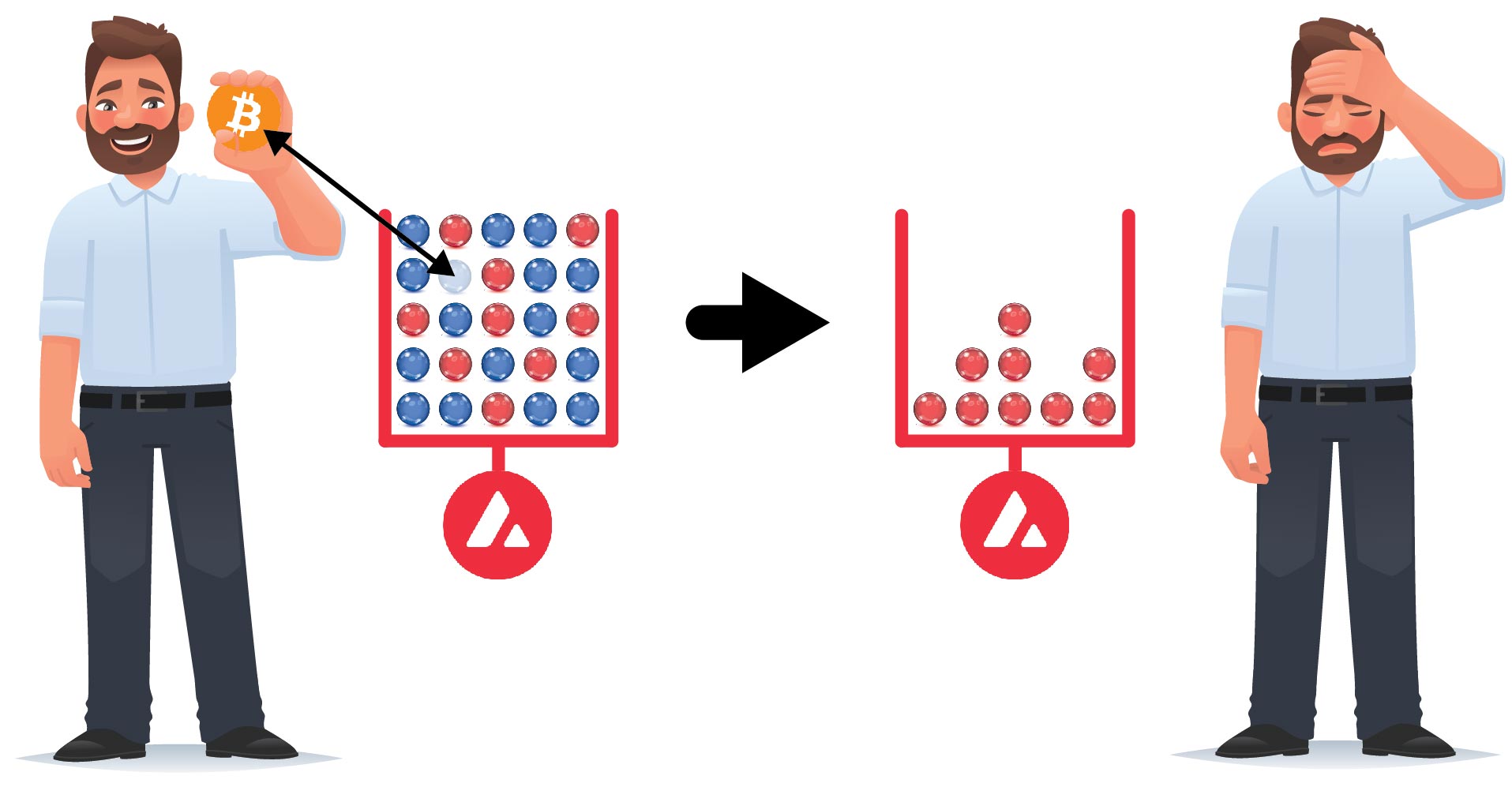
Blue marble, red marble
The pool of assets that Ava Labs maintains for the Avalanche Bridge, which backs the wrapped assets, can be thought of as a bag of marbles. Bona fide balances are blue marbles; tainted or stolen balances are red marbles. To avoid loss, a retail user must redeem their wrapped assets for blue marbles, and must do so while the bridge remains free to operate.
How the bridge was built
Ava Labs built the Avalanche Bridge in a centralized way and did not add systems that properly checked the source of deposits. Avalanche was created by adapting the open-source software behind Ethereum into a new proof-of-stake network; the DeFi applications cloned from Ethereum needed the assets held there, and the bridge was Ava Labs' answer. We have covered the company before in Case 3 and Case 5.
As a former Ava Labs engineer explained on video in Case 5, the bridge depends on centralized trust in Ava Labs. Rather than developing a provably secure public network protocol, Ava Labs built the bridge on SGX "security hardware," which runs secret code developed by the company inside a private "enclave." The enclave obscures the bridge's workings, and with them the movement of assets, which is what makes a service attractive as a mixer.
Clip 1 · Richardsthe bridge runs "code that no one's allowed to see"; "if three of them were hacked or just decided to collude, they could print an arbitrary amount of money"
| “ | all running code that no one's allowed to see. There are many documented exploits of the hardware they're using ... if three of them were hacked or just decided to collude, they could print an arbitrary amount of money on the Avalanche network |
Our view: a bridge that takes custody of its users' assets, and whose operators see every deposit, is in a position to check where those deposits come from. The tracing data shows that it did not, and that the cost has been passed to its retail users.
What happened next
August 29, 2023. Case 8 recorded that Ava Labs had not commented on the tracing data and had continued to operate the bridge. It cited a CoinDesk report of January 23, 2023, four months before this case, that the hackers of the Harmony bridge had moved part of their $100 million haul through Avalanche, Ethereum and Tron.
October 15, 2024. Case 11 recorded that an Australian journalist with no connection to Crypto Leaks had filmed Emin Gün Sirer, the chief executive of Ava Labs, walking out of an interview; to the best of our knowledge he had been asked about the findings published here. Drew Pierson, Ava Labs' former director of communications, refers to the episode on video in Case 11; the recording is public. The date of the interview is not stated.
What later cases revealed
This case asked whether Ava Labs would act to protect the users it had drawn into the bridge. Two later cases record what the company did, and what its former staff said about how centralized its operations were. The section below was added in the October 2026 revision.
- Case № 8Aug 2023
Ava Labs did not respond and kept the bridge running. Three months after this case, Case 8 recorded that the company had not commented on the tracing data and was still operating the bridge, and cited a third-party report of stolen Harmony funds passing through Avalanche. Read Case 8.
- Case № 11Oct 2024
Centralization went well beyond the bridge. Fabio Barone, a former Ava Labs engineer, says on video that the company was "maintaining more than 100 servers" as Avalanche validators and kept the rewards; Pierson calls the Avalanche Foundation's claimed governance "a dog and pony show." The same case records Sirer walking out of an interview when asked about this case. Read Case 11.
Ava Labs has not answered the question this case put in May 2023. Nothing we have seen since shows that the pool backing the Avalanche Bridge was frozen, audited or cleaned.
What must happen now
- Ava Labs should freeze the pool of assets backing the Avalanche Bridge and provide them to the relevant authorities, so that stolen and sanctioned assets cannot be withdrawn and redistributed through the crypto ecosystem.
- Ava Labs should create a "compensation service" that lets holders of wrapped assets redeem them for assets that are not stolen or tainted, bought from exchanges such as Coinbase or Binance. Promoting AVAX to retail investors made the company, its founders and its investors wealthy; it is time for them to backstop their community.
- Emin Gün Sirer and Ava Labs should make a public statement, engage organizations that can deal with the tainted assets they hold, and suspend the bridge until the flaws that let it be used as a mixer are addressed.
Video evidence index
One clip is embedded above, in the order it appears. Each entry links to the clip on this page and to its file.