A note on this investigation
Crypto Leaks collects and publishes evidence in the public interest, in accordance with the laws of the jurisdictions in which it is gathered. This case contains no covert video: its evidence is the price and volume data published by the FTX exchange for its ICP-PERP contract, together with public documents, articles and screenshots. The people named in this case were not contacted for comment before publication. Where we describe conduct as suspicious or unexplained, we are expressing our opinion that it warrants explanation, not stating that wrongdoing has been proven.
Key findings
- On May 6, 2021, four days before the Internet Computer's genesis, FTX listed ICP-PERP, a perpetual futures contract on ICP traded on FTX alone; by FTX's own data it opened at $114.40 and stood at $176.89 at 10am Pacific on May 10.
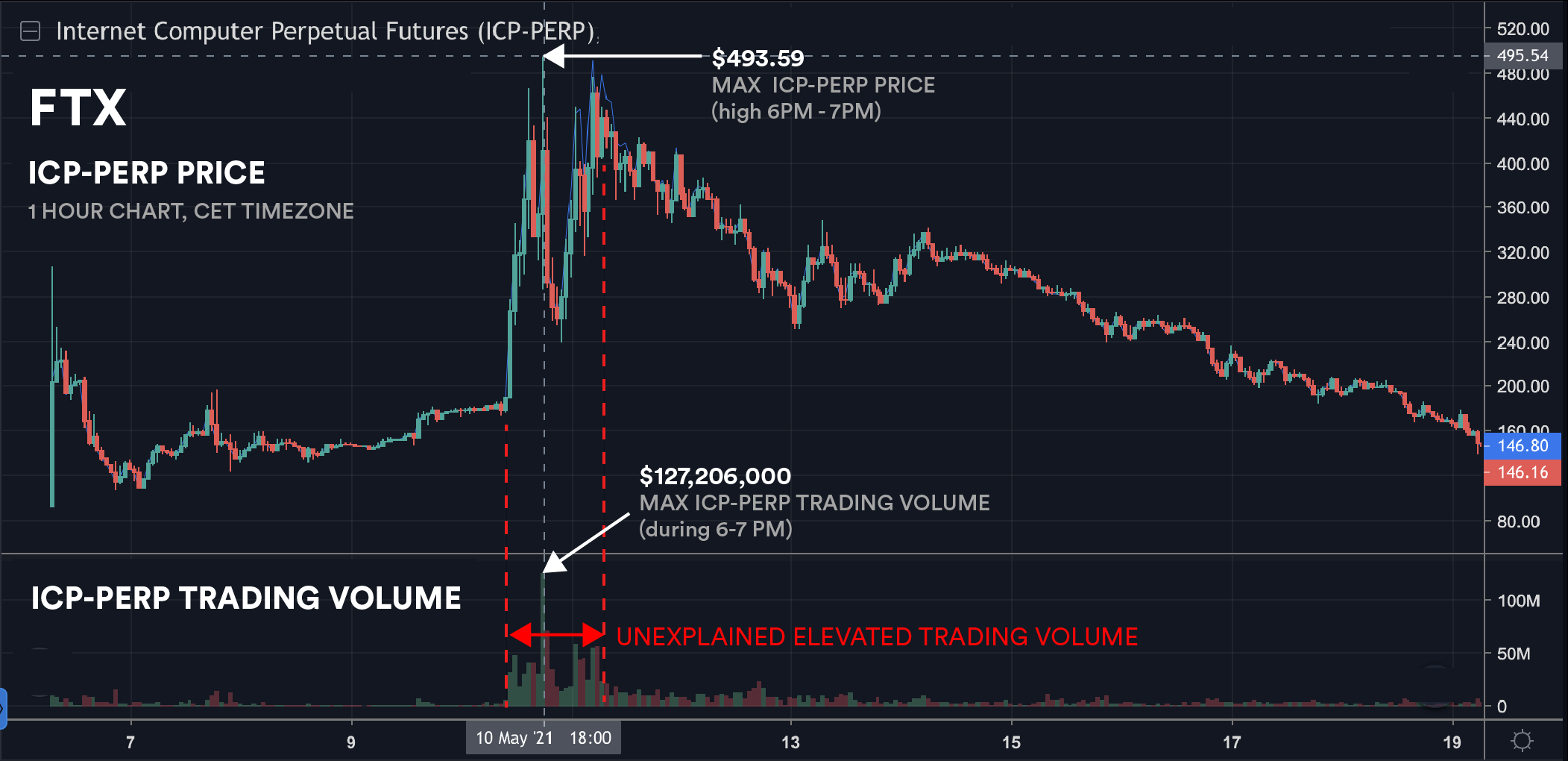
- From 11am Pacific on May 10, ICP-PERP volume rose 30 to 40 times above the preceding days, and $241,360,000 of the contract changed hands in the seven hours before genesis at 6pm.
- In the hour after genesis, volume reached $127,206,000, more than 250 times the preceding days, and ICP-PERP printed an all-time high of $494.29; futures and spot prices converge, so this set the opening price of real ICP.
- The last volume spike, $55,914,000, came after 5am on May 11, when ICP reached $476.75 on spot markets; by about 7am volume normalized and the price fell 76 percent in ten days, against 34 percent for bitcoin.
- Within seven weeks the fall had been reframed as a "rug pull" by Arkham Intelligence's report, promoted the same day by The New York Times and cited in two class actions; a law firm's paid press release briefly stated as fact that insiders "illegally sold ICP".
- Sam Bankman-Fried owned the exchange, the market maker Alameda Research and, by many accounts, the largest stake in Solana, a competing network; the original said the evidence of his involvement was circumstantial, and this edition keeps that position.
Synopsis
Four days before the Internet Computer's genesis, FTX listed ICP-PERP, a futures contract that let traders bet on the price of ICP before the token could be traded anywhere. FTX's own data shows that in the hours around genesis on May 10, 2021, ICP-PERP volume rose to more than 250 times its earlier level and its price to $494.29. Because futures and spot prices converge, that set ICP's opening price above $450, a fully diluted valuation of $230 billion. The volume vanished the next morning and the price fell 76 percent in ten days. The fall became the basis for a report, a newspaper story and two lawsuits alleging a rug pull. FTX's owner, Sam Bankman-Fried, also owned a market maker and a large stake in a rival network. We showed motive and means. We did not show that he did it, and we said so.
What FTX's own data shows
The Internet Computer is a public blockchain developed over several years by the DFINITY Foundation, a Swiss not-for-profit with a large research and engineering team. Its "genesis" on May 10, 2021 made balances of its ICP token transferable, and that evening exchanges opened spot markets, where real tokens trade and prices are set by price discovery. Four days earlier, on May 6, FTX had listed ICP-PERP.

A perpetual future tracks the price of an asset without expiring, in effect a contract-for-difference settled in cash. Before genesis no real ICP could be traded anywhere, so ICP-PERP was the only market on which a price for ICP existed, and it existed only on FTX. The figures below are FTX's own, as set out in the original edition.
| Time (Pacific) | ICP-PERP price | Hourly volume | Multiple of baseline | Note |
|---|---|---|---|---|
| May 6, 2021 | $114.40 | Baseline | Baseline | ICP-PERP listed on FTX, four days before genesis |
| May 10, 10am | $176.89 | Normal | Normal | Eight hours before genesis; the price had grown slowly since listing |
| May 10, 11am to 6pm | $275.67, $344.21, $329.09, $388.16, $466.22, $432.89, $358.34 | $241,360,000 over seven hours; more than $34,480,000 an hour on average | 30x to 40x | Volume surge begins at 11am; prices listed in the order the original gives them |
| May 10, 6pm | Genesis; Coinbase, Binance and other exchanges open spot markets in real ICP | |||
| May 10, 6pm to 7pm | $494.29 (all-time high) | $127,206,000 | More than 250x | ICP-PERP moving the spot price in real time |
| May 11, after 5am | $476.75 (spot) | $55,914,000 | Not stated in original | Last high in ICP-PERP volume; ICP reaches $476.75 on spot markets |
| May 11, about 7am | Normal | Back to baseline | Volume suddenly normalizes; the ICP price begins to fall | |
| May 20 | Down 76% (Coinbase spot) | Ten days after genesis; bitcoin down 34% over the same period |
The graph shows price (top) and volume (bottom): volume jumped after 11am as the price rose almost vertically, stayed elevated after genesis until the peak was firmly established, then dropped off sharply. The data comes from the FTX exchange itself.
Why the perpetual set the spot price
ICP-PERP and real ICP track one another because of arbitrage: if the perpetual trades above the spot price, traders profit by selling the perpetual and buying the token, and that buying pushes the spot price up. If ICP-PERP is higher than ICP, and has strong support, ICP will be pulled upward to meet it. After 6pm on May 10, ICP-PERP was influencing the spot price in real time. By holding the price at these highs for some hours, whoever was trading ICP-PERP conditioned holders and buyers to treat the opening range as a reasonable market price. The public could not know it had been set on FTX before the token became transferable.
What the volume pattern means
Manipulators raise prices by creating the illusion of demand, through wash trading (the same party as buyer and seller), sock-puppet accounts or a burst of aggressive buying. The signal of all three is volume that suddenly becomes elevated. That is what the ICP-PERP data shows: a surge that begins seven hours before genesis, peaks in the hour after it, and stops the next morning. Price and volume cannot say who was trading. The one record that could, the trade log, was held by FTX.
The bitcoin crash
Most tokens move with bitcoin, which fell 34 percent in the ten days after genesis. ICP would have fallen in any case; because its genesis price had apparently been driven about three times above its natural level, the effect was magnified, and ICP fell 76 percent. A market capitalization of more than $230 billion fell by more than $200 billion in six weeks.
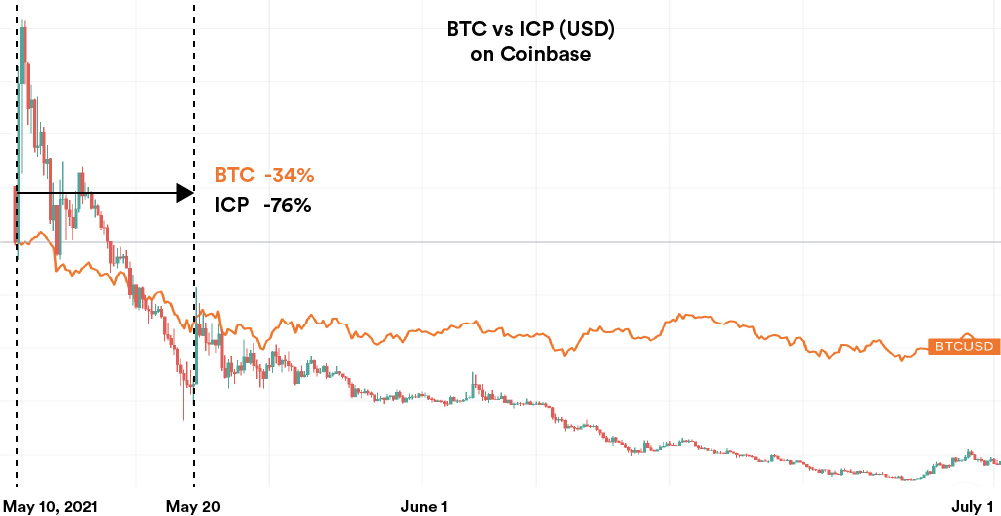
The 76 percent figure uses Coinbase spot market price data and the sustained price high of $491, not the "drop-in" price that occurred momentarily after genesis, which some data feeds show.
The attacks that followed
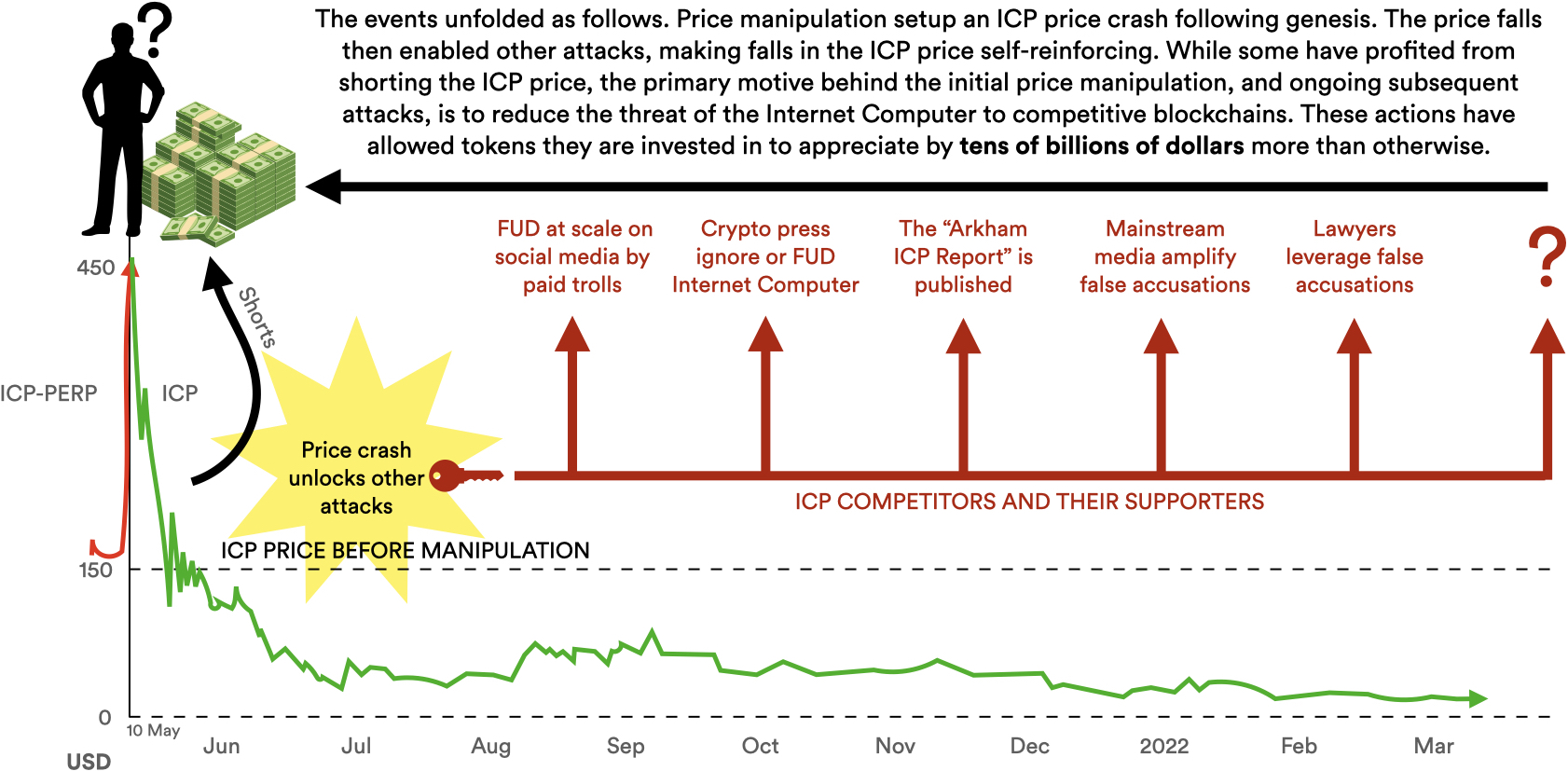
Crypto has long been plagued by "pump and dump" schemes, so a sharp rise and collapse is read as insiders inflating the price and selling, a "rug pull". Whoever set the ICP price three times too high would have known that. Social media went first: a Reddit post claiming the DFINITY team was fake (deleted; archived; still repeated in April 2022); Max Keiser calling the project a rug pull while criticizing a podcaster who had interviewed DFINITY's founder; rug-pull claims tweeted, posted to Reddit and made into videos; and a poster claiming to be a 2018 presale participant mistreated by vesting, though the presale terms always provided for twelve monthly installments.
The Arkham report and the Times
On June 28, 2021, a previously unknown company, Arkham Intelligence, and its equally unknown founder, Miguel Morel, published a report claiming the project was a rug pull, promoted with a professionally produced video. Morel said: "I was not hired or compensated to release this report". The video opens with a graph showing the price falling from around $800, a momentary drop-in print, not a sustained level.
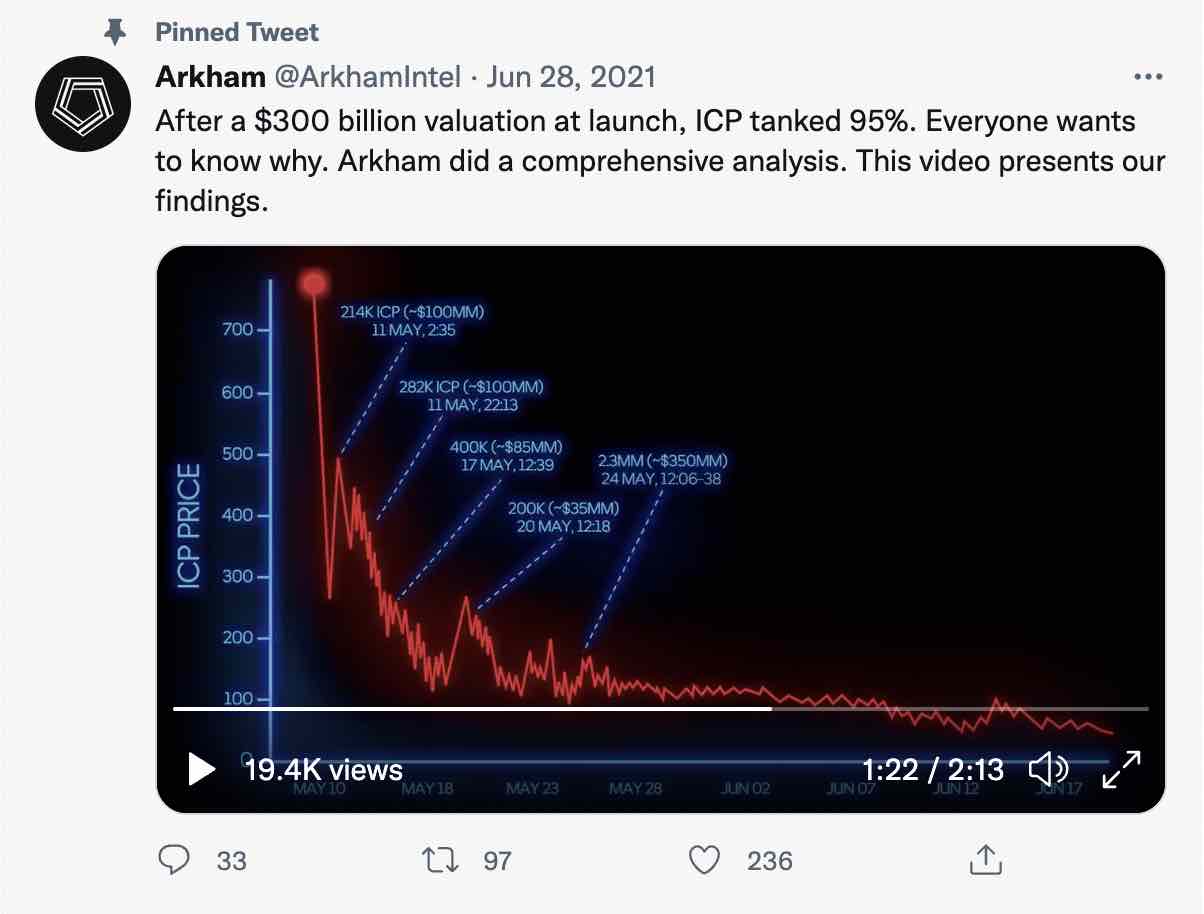
Morel says in the video that "this was not a coincidence or accident, but was a case of misconduct by those who seem closely connected to ICP". DFINITY has said it sold no ICP for weeks after genesis and its founder sold less than 5 percent of his holding (CryptoSlate, Twitter, Reddit).

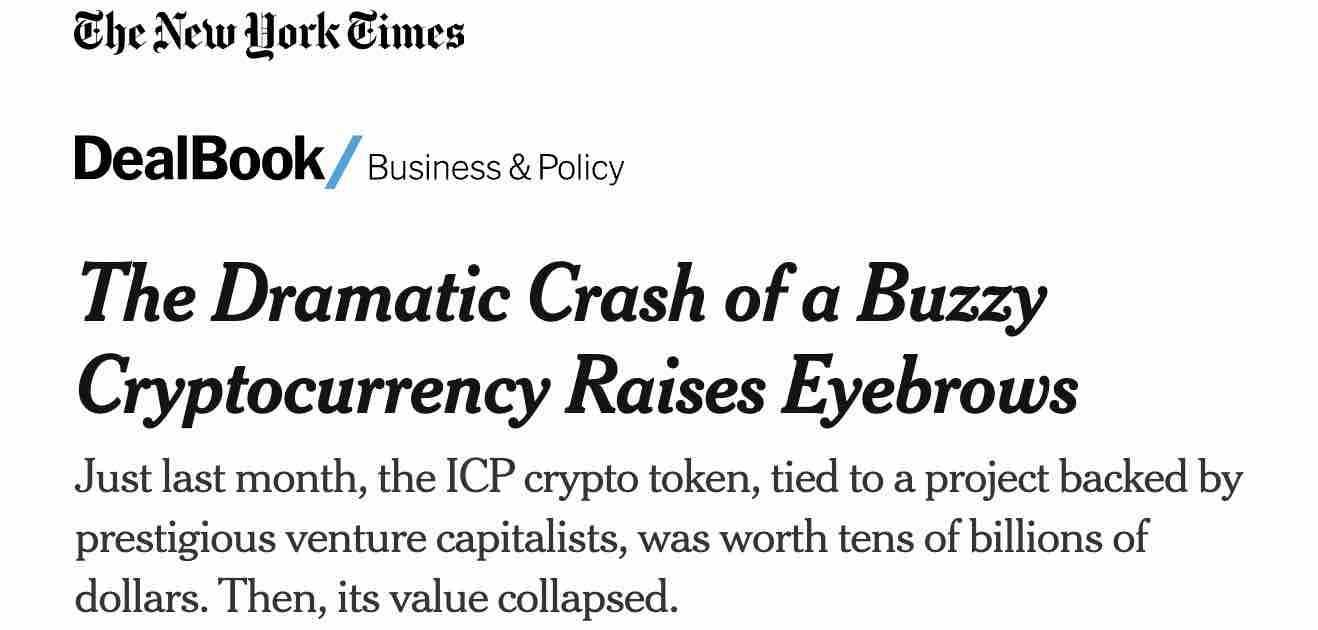
The same day, The New York Times published an article and a DealBook newsletter item presenting Arkham as a credible analysis firm, and repeatedly called the genesis event an "I.C.O.", a fundraising practice regulators have long targeted; it was nothing of the kind. The Times gave Arkham's claims a worldwide audience and, in our view, cost ICP holders billions more.
What later cases found
- Case 2 (June 2022): Arkham insiders said on tape that the report was made to order for a client one of them called a "business rival", that its claims were not built on a proper foundation, and that the work was done with funding from Tim Draper.
- Case 12 (November 2025): Arkham's former chief growth officer said on video that the company paid "FTX's PR people", M Group, $275,000 a year before it had a product. Former staff placed its founders in Sam Bankman-Fried's circle, introduced through FTX's chief technology officer Gary Wang, and with Bankman-Fried in the Bahamas the day before FTX collapsed.
- Both cases trace how the report reached The New York Times.
ICP Reboot and the class actions
In July 2021 an anonymous project, ICP Reboot, announced "a community-driven project to right the wrongs committed by dfinity's leadership" by forking the network. In November 2021 Brenden Rearick, a widely syndicated writer, presented it as a legitimate alternative and five weeks later argued that ICP holders should sell. The crypto press otherwise led with the Arkham report, ICP Reboot and the lawsuits (CoinDesk, August 17, 2021); much of it has interested owners, Decrypt belonging to ConsenSys, whose business is Ethereum.

Two class actions were filed in July and August 2021, each claiming that ICP is an unregistered security and that the price fell because of insider selling, and each citing the Arkham report. The first was filed by Scott & Scott of San Diego in California state court; the second by Roche Freedman of Miami in federal court. Court filings are protected speech in the United States, and discovery opens a defendant's confidential information to the plaintiff whether or not the claim succeeds.

Roche Freedman also bought a press release on Cointelegraph headed "DFINITY insiders alleged to have illegally sold ICP and harmed retail investors". The screenshot above, from an Android phone's newsfeed, shows the headline as Google indexed it, with "alleged to have" removed, so that an unproven allegation reached millions of newsfeeds as fact; the title was then changed back. The original called this the deliberate exploitation of a loophole in defamation law, and that remains our reading. Case 3 is what our recordings later showed about Roche Freedman.
Exchange, market maker, investor
Regulated markets separate three roles. The exchange runs the venue and sees every order, including other traders' stop-losses and leverage. The market maker stands ready to buy and sell, which gives markets depth but also the power to move prices. The investor holds positions whose value depends on where prices go. Securities law keeps them apart because the history of stock and commodity markets shows what happens when one party can see the order book, trade against it and profit. Crypto's centralized exchanges had no such rules in 2021.
Sam Bankman-Fried held all three roles at once. Alameda Research, which he founded in 2017, became one of crypto's largest hedge funds and then a market maker. FTX, launched in 2019, was the exchange that created and listed ICP-PERP. And by many accounts he was the largest investor in Solana, which he promoted widely without disclosing his position. People who dealt with FTX staff on Zoom described asking a question for Alameda and hearing it relayed across the room. In February 2022 Jump Trading, another combined market maker and hedge fund, took a $320 million loss to make good the Wormhole bridge hack and protect its own Solana stake; the Solana Foundation offered builders grants of up to $10 million; on November 6, 2021, SOL's fully diluted market capitalization peaked at $132 billion. FTX had a Super Bowl advertisement and sports sponsorships, and its owner was, by The New York Times' account in May 2022, worth $21.2 billion and ready to spend up to $1 billion on the 2024 election.
What we got wrong

The diagram above, from the original edition, showed Alameda's trading profits feeding FTX and both feeding investment in Solana, in a loop we called self-reinforcing. Case 4, published in April 2023, called it "an over simplification, but correct in many important respects": it missed that the money flowing into Bankman-Fried's chosen ecosystem was not only trading profit but, as a federal jury later found, assets taken from FTX customers. We record the correction here.
The motive we proposed
Our argument in June 2022 was that Solana was Bankman-Fried's competing bet and that the Internet Computer threatened its pitch: speed, efficiency, scale, and hosting services such as social media on the blockchain. The Internet Computer claimed to run such services entirely on-chain at very different costs: Solana's documentation gave a storage rent of 3,480 SOL a year per gigabyte, about $348,000 at $100 a token, against about $5 a year on the Internet Computer. Investors backed Solana, as Kevin O'Leary said, because of "Sam Bankman Fried and his team". A rival doing what Solana aspired to do, at a fraction of the cost, in the 2021 bull run, would have been unwelcome to anyone with billions in Solana. That was the motive. It was, and remains, an inference.
At the Crypto Goes Mainstream conference in November 2021 Bankman-Fried said:
| “ | Solana is one of the few currently existing public blockchains that has a really plausible road map to scale millions of transactions per second at, you know, fractions of a penny per transaction, which is a scale that you need for this |
At Solana Breakpoint, also in November 2021, he said:
| “ | I think social media on the blockchain — I continue to think this could be absolutely huge. I think it solves a lot of existing pain points, which are really coming to the forefront of society right now. |
Figures 1, 2 and 3 draw the contrast that mattered. On the Internet Computer, the web experience, the data and the computation all live on the blockchain. "Built on Solana" was taken to mean the same thing by the overwhelming majority of the public, token investors, and crypto and mainstream journalists. However, the reality was very different, yet Solana, like many blockchain projects, continued to foster the misconception. Given the scale of the Internet Computer project, there were inevitable fears that its very different capabilities would help the world understand the reality.
About a month after genesis, in a video interview, Solana's chief executive and chief scientist, Anatoly Yakovenko, asked to "FUD one other project", chose the Internet Computer: "I know I kind of 'dunked on' DFINITY, right... earlier" and "I feel bad about saying bad about anyone else". The exchange starts at 1:32:20. We draw no conclusion from it about what he knew of ICP-PERP.
Earlier allegations against Alameda Research
Alameda had been accused of market manipulation before. In September 2019 Binance's chief executive said a market maker from a smaller futures exchange had tried to attack Binance's futures platform; it was alleged that the market maker was Alameda. A lawsuit followed and was closed as voluntarily dismissed with prejudice, which often, though not always, indicates a settlement. In 2022 traders accused Alameda on Twitter of manipulating crypto markets broadly and of attacking a project competing with Solana; CoinGeek published similar allegations. None was tested in court. We cited them as context, not proof.
Our view: the ICP-PERP surge has the signature of a deliberate operation by someone with large capital, trading systems and a reason to want the launch to end in a crash. Bankman-Fried had the venue, the market maker and the motive. That is circumstantial. It does not establish that he, Alameda or FTX placed the trades, and the original said so in terms: "This of course, does not mean that he performed the attack." Only the trade log could settle it, and in June 2022 we asked FTX to release it.
What happened next
- June 2022. After Case 2, the DFINITY Foundation sued The New York Times and Arkham for defamation in federal court in Manhattan (complaint filed June 27, 2022), and the Times removed "I.C.O." from its newsletter headline, as Case 2 records. Judge Lewis Kaplan dismissed the suit before trial on November 13, 2023, holding that DFINITY, as a public figure, had not pleaded actual malice (opinion); the Second Circuit affirmed on July 29, 2024 (appeal No. 23-7838). The evidence of Arkham's FTX connections came after the complaint was filed. Case 2 carries a special section setting out the evidence the court never weighed, the complexities of the case, and what difference that evidence would have made.
- November 2022. FTX Trading and about 130 affiliates, Alameda Research among them, filed for Chapter 11 bankruptcy in Delaware on November 11, 2022, and Bankman-Fried resigned as chief executive (case 22-11068, claims agent docket; Al Jazeera).
- December 2022. Bankman-Fried was arrested in the Bahamas on December 12, 2022 and charged in Manhattan with wire fraud, securities and commodities fraud conspiracies, money laundering conspiracy and campaign finance offences (US Attorney, Southern District of New York). Gary Wang, FTX's co-founder and chief technology officer, pleaded guilty to conspiracy to commit wire fraud on December 19 and agreed to cooperate (US Attorney, SDNY).
- October 2022 to May 2023. Judge Katherine Polk Failla removed Roche Freedman as interim class counsel in the Tether and Bitfinex class action on October 13, 2022, after the Case 3 recordings (Bloomberg Law); the firm dropped Roche's name and continued as Freedman Normand Friedland (Law360); and on May 8, 2023 Judge James Donato declined to let the renamed firm serve as lead counsel in the class action it had brought against DFINITY (order; Law360). Case 12 later reported that the firm had disbanded.
- April 7, 2023. Neither Bankman-Fried nor FTX had responded to the June 2022 request to release or analyze the ICP-PERP trading records. No response has been received since.
- November 2023. On November 2, 2023 a federal jury in Manhattan found Bankman-Fried guilty on all seven counts of fraud and conspiracy (Justice Department; Al Jazeera). The trial record established that FTX customer assets had been used by Alameda, the commingling this case could only infer in 2022.
What later cases revealed
This case ended with a request for evidence it could not obtain. Later cases did not produce the trade log, but they filled in what surrounded it. This section was added in the October 2026 revision.
- Case № 3Aug 2022
Roche Freedman was financed by a rival blockchain's developer. On covert video, lead partner Kyle Roche described suing competitors of Ava Labs, the company behind Avalanche, and steering regulators toward them, for assets worth hundreds of millions of dollars. The firm behind the second class action and the edited headline was not an independent actor. Read Case 3.
- Case № 4Apr 2023
An FTX insider said on camera there were "no boundaries" between FTX and Alameda. Lynn Nguyen, FTX's former head of settlements, said Bankman-Fried "knows everything that's like, went on with FTX and within Alameda", that the exchange was focused on promoting Solana, and, asked about ICP's launch, "Oh, it's just market manipulation." Case 4 also corrected this case's diagram of Bankman-Fried's businesses. Read Case 4.
- Case № 12Nov 2025
Arkham paid "FTX's PR people" $275,000 before it had a product. Arkham's former chief growth officer said on video that the company paid $275,000 a year to M Group, the PR firm that worked for FTX and Bankman-Fried and has been reported to work closely with Andrew Ross Sorkin of The New York Times; former staff said Arkham's founders were friends of Gary Wang, FTX's co-founder. Whether the payment relates to the Times' publication of the ICP report remains open. Read Case 12, which reworks Case 10.
The Arkham thread runs on through Case 2 to Case 13 and Case 14; Case 7 follows the Times' later coverage. In 2022 this case could show a trading pattern on one exchange and a set of relationships that regulated markets would not permit. What has emerged since is that the exchange and the market maker were in practice one business, run to promote Solana, and that the firm which turned the crash into a "rug pull" was connected to the same circle. Who placed the ICP-PERP trades has not been identified in any public record we have seen.
What must happen now
- Whoever holds FTX's trading records after its bankruptcy should release the ICP-PERP trade log for May 6 to 11, 2021, with account identities, to law enforcement in the United States and Switzerland, so that the traders can be identified and innocent parties cleared.
- Anyone with knowledge of who traded ICP-PERP in those hours can contact Crypto Leaks at whistleblowers@cryptoleaks.info or @CryptoLeaksInfo.